

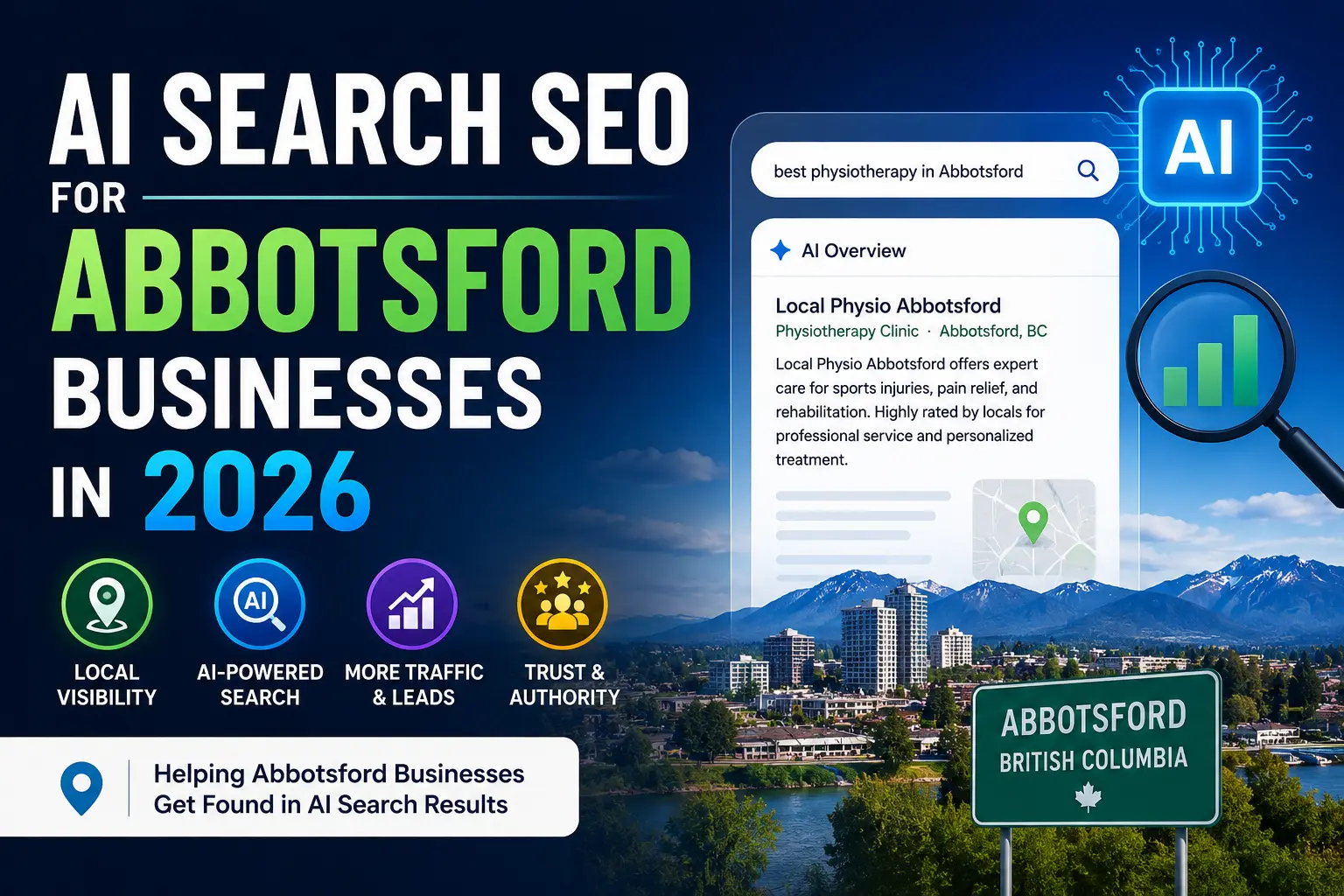
Search is changing. People still use Google to find local businesses, but they are also asking longer, more conversational questions through AI-powered search experiences.
Instead of typing:
“plumber Abbotsford”
a customer might ask:
“Who can fix a leaking water heater in Abbotsford today?”
Or:
“Which physiotherapy clinic in Abbotsford is suitable for a sports injury?”
These searches are more specific because the customer is not simply looking for a website. They want an answer, a recommendation, or a shortlist of businesses that fit their situation.
For local companies, this creates a new SEO challenge.
Your website needs to be easy for customers to understand, but it also needs to provide enough reliable context for modern search systems to connect your business with relevant questions.
That is where AI Search SEO for Abbotsford businesses comes in.
It is not a replacement for local SEO. It is an extension of good SEO, content, technical optimization, and online reputation management.
What Is AI Search SEO?
AI Search SEO is the process of improving a website and its broader online presence so search systems can understand the business, its services, its location, its expertise, and the questions it can answer.
Traditional SEO often concentrates on rankings, keywords, technical performance, links, and search intent.
AI-powered search adds another layer of understanding.
Search systems may need to determine:
- What does this business actually offer?
- Which customers does it serve?
- Where does it operate?
- What type of problem does it solve?
- What evidence supports its expertise?
- Is the information consistent across different sources?
- Does the website provide a useful answer to the customer’s question?
Google’s current guidance does not recommend a special shortcut or secret optimization method for appearing in generative AI experiences. Instead, Google continues to emphasize strong SEO fundamentals, useful content, clear information, and original value.
For an Abbotsford business, that means the best approach is not to chase every new AI trend. The better approach is to build a website and online presence that clearly communicate the value of the business.
Why AI Search Matters to Local Businesses in Abbotsford
Local search is highly specific.
A customer looking for a physiotherapist may care about treatment type, location, availability, and experience. Someone searching for a roofing contractor may want help with a leak, storm damage, or a roof replacement.
The more specific the question becomes, the more important detailed business information becomes.
For example, consider the difference between:
“SEO Abbotsford”
and:
“What should a small Abbotsford business look for when choosing a local SEO agency?”
The second question requires context.
A useful answer may involve business type, local competition, Google Business Profile optimization, website structure, content, reviews, citations, and conversion tracking.
This is why businesses should create content and service pages that explain their expertise instead of relying on a single page filled with keywords.
The objective is simple:
Make your business easy to understand, easy to verify, and genuinely useful to the people you want to serve.
10 AI Search SEO Strategies for Abbotsford Businesses
1. Create Strong Pages for Your Main Services
Many local businesses make the mistake of putting every service on one general page.
That makes it harder for both visitors and search systems to understand what the business actually specializes in.
A better structure is to create a dedicated page for each important service.
For example, an Abbotsford physiotherapy clinic might have separate pages for:
- Physiotherapy
- Sports Injury Treatment
- Chronic Pain Treatment
- Kinesiology
- Massage Therapy
- Post-Surgical Rehabilitation
A strong service page should answer practical questions such as:
- What is the service?
- Who may need it?
- What problems can it address?
- What does the process involve?
- What should a customer expect?
- When should someone contact the business?
- How can the customer book or get more information?
Do not create separate pages simply because you want to target more keywords.
Each page should exist because it serves a real customer need.
That approach also reduces the risk of creating large numbers of thin, nearly identical pages.
2. Build Content Around Real Customer Questions
One of the biggest opportunities in modern search is answering questions that customers naturally ask.
Instead of choosing blog topics only because a keyword has search volume, look at the conversations your sales team, reception staff, technicians, or customers already have.
Examples include:
For a physiotherapy clinic:
- How long does physiotherapy usually take?
- What happens during a first physiotherapy appointment?
- Can physiotherapy help after a sports injury?
- When should I see a physiotherapist?
For a plumber:
- How do I know if a plumbing leak is serious?
- What should I do before a plumber arrives?
- When should a water heater be repaired or replaced?
For an SEO agency:
- How much does local SEO cost for a small business?
- Why is my business not appearing in Google Maps?
- How long does local SEO usually take?
This type of content can be valuable because it addresses the customer’s decision-making process rather than simply repeating commercial keywords.
Google’s people-first content guidance encourages original information, useful analysis, and content that satisfies the reader without forcing them to continue searching for a better answer.
3. Make Your Local Business Information Consistent
AI search cannot make your business clearer if your online information is contradictory.
Your website should present accurate information about:
- Business name
- Address
- Phone number
- Hours
- Service area
- Main services
- Website
- Contact details
- About the company
The same core information should also be accurate on your Google Business Profile and other relevant business listings.
Suppose your website says you serve Abbotsford and Mission, while another important profile lists a completely different service area.
That inconsistency can create uncertainty for customers and search systems.
Keep location information natural and useful. Do not create dozens of pages with nearly identical text simply to target every nearby city.
A location page should have a legitimate purpose and provide information that is genuinely relevant to customers in that area.
4. Fully Optimize Your Google Business Profile
Your website is only one part of local search visibility.
For businesses serving customers in Abbotsford, the Google Business Profile should be complete and accurate.
Review the important elements of your profile regularly, including:
- Primary business category
- Relevant secondary categories
- Business description
- Services
- Business hours
- Phone number
- Website
- Address or service area
- Business photos
Google explains that managing a Business Profile gives businesses more control over key information shown in Google Search and Maps.
Your profile and website should support the same business identity.
That means the business name, services, location, and contact information should make sense across the two.
The goal is not to stuff your profile with every possible keyword.
The goal is to make the profile useful to someone who is ready to choose a local business.
5. Build a Real Review Profile
Reviews influence how potential customers evaluate a local company.
A detailed review that mentions the customer’s actual experience can provide much more context than:
“Amazing service!”
For example, a natural review might explain that a customer contacted a local plumber about a leaking pipe, received clear communication, and had the issue repaired promptly.
Businesses should encourage genuine customers to leave honest feedback.
Never purchase reviews, create fake reviews, or ask customers to publish misleading claims.
Your review profile should support the same story your business tells elsewhere.
If your website says you specialize in a particular service, your customer experience and reviews should naturally reinforce that reputation.
Authenticity is far more valuable than trying to manufacture a perfect-looking profile.
6. Use Structured Data Where It Makes Sense
Structured data gives search engines a standardized way to interpret information on a webpage.
For local businesses, appropriate LocalBusiness structured data can communicate information such as business details and operating hours.
Google provides specific documentation for LocalBusiness structured data and recommends validating markup before deployment.
Depending on your website, relevant structured data may include information about:
- Business identity
- Address
- Phone number
- Opening hours
- Website
- Organization details
- Services
Structured data should reflect the information that actually appears on the page.
It is not a secret ranking switch, and adding schema does not guarantee that a page will receive a special search feature.
Think of structured data as a way of making already-visible information easier for search engines to interpret.
7. Show Evidence of Real Expertise
AI has made it easier to produce generic articles.
That creates a bigger opportunity for businesses that can demonstrate real knowledge.
Your content should answer:
Why should someone trust this business?
A local roofing company, for example, could explain common roofing problems in the Fraser Valley and what homeowners should check before hiring a contractor.
A physiotherapy clinic could explain what patients should expect during an initial assessment.
An accounting firm could publish practical guidance for local small-business owners preparing for tax season.
Strong content should include useful observations, examples, explanations, and experience-based advice.
Avoid inventing:
- Certifications
- Awards
- Years of experience
- Client results
- Testimonials
- Case studies
- Industry credentials
Google’s current guidance specifically encourages original, non-commodity content and unique points of view rather than simple rewrites of information that already exists online.
8. Strengthen Your Local Authority
Your website does not exist in isolation.
Search engines can encounter information about your business through relevant directories, associations, partners, publications, organizations, and other legitimate websites.
For an Abbotsford company, useful sources might include:
- Local business directories
- Professional associations
- Industry organizations
- Chamber or community resources
- Local publications
- Partner businesses
- Supplier websites
- Relevant sponsorship or community pages
The objective is not to obtain hundreds of directory links.
That approach can create clutter without creating meaningful authority.
Instead, prioritize sources that are relevant to your industry and location.
A few credible references are more useful from a business perspective than a large collection of low-quality listings.
9. Write for Conversational Searches
Customers do not always search using short keyword phrases.
They may type full questions into Google or speak naturally through voice-enabled devices.
That means your content should also use natural language.
For example:
Question:
What does sports injury physiotherapy involve?
Answer:
Sports injury physiotherapy typically focuses on reducing pain, restoring movement, rebuilding strength, and helping the person return safely to normal activity or sport.
Then provide additional information about assessment, treatment, recovery, and when professional advice may be appropriate.
This structure works because the customer gets the answer quickly and can continue reading for details.
The important point is not to manufacture every possible question as a separate page.
Use questions where they genuinely improve the content.
10. Measure Business Outcomes, Not Just Rankings
A successful local SEO campaign should not be judged by one keyword position.
Rankings can fluctuate, and a first-page position does not automatically mean the business is generating revenue.
Track metrics that connect search visibility to business performance, such as:
- Organic traffic
- Search impressions
- Click-through rate
- Leads
- Phone calls
- Contact form submissions
- Google Business Profile interactions
- Important landing-page traffic
- Organic conversions
- Local search visibility
Google announced new generative AI performance reporting in Search Console in June 2026. The reporting includes visibility from generative AI features such as AI Overviews and AI Mode, but Google says the reports are initially being rolled out to a subset of websites.
As these tools become more widely available, businesses can use them alongside traditional SEO and conversion data.
How AI Search SEO Differs From Traditional SEO
Traditional SEO and AI-focused search optimization are not two completely separate systems.
They share many of the same foundations.
The difference is mainly in what your content must accomplish.
| Traditional SEO Focus | Modern AI Search Focus |
| Keywords | Topics, questions, and intent |
| Rankings | Visibility and inclusion in answers |
| Individual pages | Connected topical coverage |
| Link building | Authority and credible mentions |
| Search snippets | Direct, useful answers |
| Local keywords | Complete local business context |
| Technical SEO | Crawlable, understandable site structure |
| Blog publishing | Original resources with real value |
A strong website can support both.
You do not need to abandon keyword research, technical SEO, local optimization, or link acquisition.
You need to make those activities support a genuinely useful website.
What an Abbotsford AI Search SEO Strategy Should Include
A practical strategy can be divided into five areas.
Website Foundation
Make sure the site has clear navigation, crawlable pages, useful service content, accurate business details, strong internal linking, and an easy path to contact the business.
Local Presence
Keep your Google Business Profile, business listings, website information, and service-area details accurate.
Content
Publish information that answers real customer questions and demonstrates knowledge that cannot be reduced to generic summaries.
Authority
Develop legitimate relationships, mentions, references, and reviews that strengthen the business’s reputation.
Measurement
Track traffic, leads, calls, conversions, and search visibility rather than focusing only on keyword positions.
Common AI SEO Mistakes Abbotsford Businesses Should Avoid
Publishing Hundreds of AI Articles
More pages do not automatically create more visibility.
Google’s guidance warns against producing large amounts of content primarily to manipulate search rankings, including scaled content that lacks meaningful value.
One genuinely useful article can be more valuable than 20 repetitive posts.
Repeating the Same Local Keyword
Writing “SEO company Abbotsford” in every paragraph does not make an article stronger.
Use natural language and cover the topic thoroughly.
Creating Fake Local Expertise
Do not pretend to have worked with businesses, served industries, or achieved results that you cannot verify.
Local relevance should come from real business information and genuine experience.
Building Thin Location Pages
Creating one almost-identical page for every nearby community can result in a poor experience.
Only create location-specific content when you can offer something useful for people in that location.
Writing for AI Instead of People
Do not turn every paragraph into a robotic answer designed only to be extracted by a search engine.
Readable structure, useful information, examples, and clear explanations still matter.
Google’s guidance continues to emphasize content created primarily to help people rather than content created mainly to manipulate search rankings.
Chasing Every New “AI SEO Hack”
The AI search ecosystem will continue changing.
Tactics that promise guaranteed AI citations, guaranteed recommendations, or instant visibility should be treated carefully.
A durable strategy is based on fundamentals:
Useful information + clear business context + technical accessibility + real expertise + trustworthy reputation.
A Practical AI Search SEO Checklist
Before publishing a page for your Abbotsford business, review the following.
Website
- Does the page solve a real customer problem?
- Is the service clearly explained?
- Is the target location obvious where relevant?
- Is the content original?
- Does the page provide useful details rather than filler?
- Can visitors easily find contact information?
Local SEO
- Is the Google Business Profile accurate?
- Are the business category and services relevant?
- Are your core business details consistent?
- Are customer reviews genuine?
- Is your service area clearly explained?
Technical SEO
- Can search engines crawl the page?
- Is the important content indexable?
- Are titles and headings descriptive?
- Does the site work well on mobile devices?
- Is the page experience strong?
- Is relevant structured data implemented correctly?
Content Quality
- Does the article answer the question directly?
- Does it add something beyond generic information?
- Does it demonstrate real expertise?
- Are examples relevant to the intended audience?
- Is it written naturally for people?
How Abbotsford Businesses Can Prepare for AI Search
You do not need to rebuild your entire online presence in one project.
Start with the pages that matter most.
Step 1: Audit Your Existing Website
Review your homepage, service pages, location information, About page, contact information, and important blog posts.
Look for outdated information, thin pages, duplicated topics, and missing explanations.
Step 2: Improve Your Highest-Value Service Pages
Start with the services that generate the most business.
Make those pages strong enough that a customer can understand the service, evaluate the business, and take the next step without needing to visit several competing websites.
Step 3: Identify Real Customer Questions
Speak with customers, sales staff, reception teams, and service professionals.
Turn recurring questions into useful articles and FAQ content.
Step 4: Strengthen Local Information
Review your website, Google Business Profile, and important business listings.
Make sure the same core facts are accurate everywhere.
Step 5: Add Appropriate Structured Data
Implement relevant markup where it accurately represents the content and business information on the page.
Google recommends validating structured data and checking how Google sees the page after implementation.
Step 6: Measure Leads and Visibility
Look beyond rankings.
Track whether organic and local search activity is producing calls, forms, inquiries, appointments, bookings, or sales.
Step 7: Update Based on Real Customer Needs
Search behavior will continue to evolve.
Your content strategy should evolve with customer questions, industry changes, new services, and actual performance data.
Frequently Asked Questions
What is AI Search SEO for Abbotsford businesses?
AI Search SEO is the process of improving a business website and online presence so modern search systems can understand its services, location, expertise, and relevance to customer questions. It builds on established SEO and local SEO principles rather than replacing them.
Is traditional SEO still important in 2026?
Yes. Google’s current guidance says SEO fundamentals remain relevant to its generative AI search experiences. A technically accessible website with useful, reliable content remains an important foundation.
Does an Abbotsford business need a blog for AI search?
No. A blog is not a requirement.
A business may benefit from educational articles, but the priority should be useful information. A smaller number of strong resources can be more valuable than publishing content simply to increase page count.
Does Google Business Profile matter for AI Search SEO?
It remains an important part of a local business’s online presence. Businesses should keep their profile accurate and complete and ensure that important information aligns with their website and other trusted sources.
Should I create an llms.txt file for AI SEO?
You should not treat llms.txt as a required Google SEO tactic.
Google’s current guidance focuses on established Search best practices and does not present an llms.txt file as a requirement for appearing in Google’s AI search experiences.
Can AI-assisted content rank on Google?
AI assistance itself is not the deciding issue.
Google states that the focus should be on accuracy, quality, relevance, originality, and value for users. Using automation to mass-produce low-value pages with the goal of manipulating rankings can violate Google’s spam policies.
Should I create a separate page for every Abbotsford neighbourhood?
Not automatically.
Only create a neighbourhood or location page when it serves a genuine user need and contains meaningful, location-specific information.
Nearly identical location pages with only the city name changed add little value.
How long does AI Search SEO take to produce results?
There is no universal timeline.
Results depend on factors such as website quality, competition, authority, content, technical health, local presence, and how closely the business matches the searcher’s needs.
SEO should be treated as an ongoing improvement process rather than a one-time project.
Conclusion
AI-powered search is changing how customers discover and evaluate local businesses, but the core requirement has not changed:
Give people a clear, useful, trustworthy answer.
For an Abbotsford business, that means making it obvious:
- What you do
- Who you serve
- Where you operate
- What makes your business credible
- How customers can contact you
Build strong service pages. Answer real customer questions. Keep your local information accurate. Maintain a trustworthy Google Business Profile. Earn genuine reviews. Use structured data where appropriate. Show real expertise. Then measure whether your search visibility is producing business results.
The businesses most prepared for AI search will not necessarily be the ones publishing the most content.
They will be the ones providing the clearest and most useful information about what they do and why customers should choose them.
That is the foundation of sustainable AI Search SEO for Abbotsford Businesses in 2026.
Sources: Google Search Central guidance on generative AI search, helpful and people-first content, generative AI content, LocalBusiness structured data, Search Essentials, and Search Console generative AI performance reporting.