

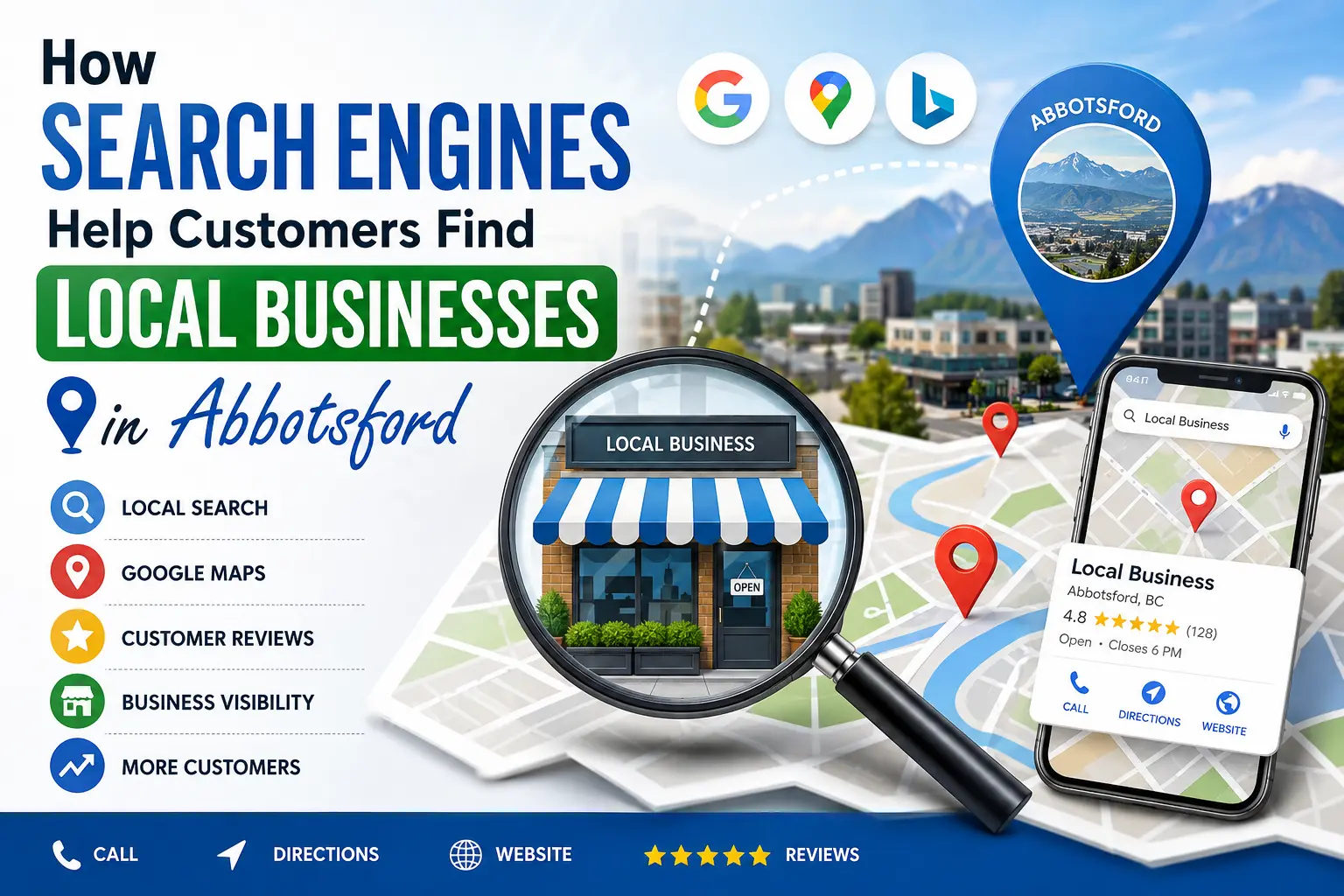
Picture someone in Abbotsford typing “physiotherapist near me” or “emergency plumber near me” into Google. Within seconds, they see a list of businesses — complete with reviews, directions, phone numbers, and opening hours.
This is how people find local businesses today. Printed directories and newspaper listings are largely gone. In their place: Google Search, Google Maps, Apple Maps, Bing, AI-powered search tools, and voice assistants. If your business shows up in these results, you have a real shot at new customers. If it doesn’t, many people will never know you exist.
Why Local Search Matters More Than Ever
Consumer behavior has shifted. Instead of asking a friend for a recommendation, people search Google — “hair salon near me,” “best chiropractor in Abbotsford,” “local bakery open today.” Google recognizes these as local intent searches, meaning the person wants nearby businesses, not ones in another city. Billions of local searches happen every month worldwide, and a large share of them lead directly to phone calls, website visits, direction requests, or in-store purchases.
What Happens When Someone Searches
Say someone types “massage therapist Abbotsford.” In the background, Google is weighing dozens of signals at once — the user’s location, business relevance, distance, reputation, website quality, reviews, Google Business Profile completeness, opening hours, and local citations. Based on all of this, it surfaces the businesses most likely to satisfy that search.
How Search Engines Understand Local Businesses
A handful of signals matter far more than the rest.
Google Business Profile. This is one of the single biggest ranking factors in local search. A complete, accurate profile — business name, address, phone number, categories, services, hours, photos, and reviews — gives Google confidence to show your business. The more current it is, the better it tends to perform.
Your website. Your site tells search engines exactly what you offer. Strong ones have clear service pages, location pages, fast load times, mobile-friendly design, and secure HTTPS. Google cross-checks your site against your Business Profile to confirm the details line up.
Customer reviews. Reviews signal trust to both customers and Google. Quantity, quality, recency, and how you respond to them all matter. A detailed review like “they repaired my roof quickly in Abbotsford and explained every step” carries more local relevance than a generic “great service.”
Location and distance. Proximity still counts. Someone searching from downtown Abbotsford will often see nearby, verified businesses first.
Website content. Content that clearly addresses your services, service areas, and the specific problems customers face builds topical authority over time.
The Role of Google Maps
Millions of people open Google Maps daily to find restaurants, clinics, contractors, and tradespeople. Maps ranks results on three factors: relevance (does the business match the search?), distance (how close is it?), and prominence (how well-known and trusted is it?).
The Local Pack
The “Local Pack” is the block of three businesses shown beneath the map for searches like “best physiotherapist Abbotsford.” It typically includes the map, business names, ratings, reviews, directions, phone numbers, and website links. Landing here can meaningfully boost visibility and inquiries.
How AI Search Is Changing Local Discovery
People are increasingly asking full questions instead of typing keywords — “who is the best family dentist in Abbotsford?” or “which café has free Wi-Fi?” AI search tools pull from Google Business Profiles, websites, reviews, directories, and structured data to answer these. Businesses with accurate, detailed, and consistent information across the web are more likely to get recommended.
Voice Search
Voice assistants like Google Assistant, Siri, and Alexa handle queries such as “find a plumber near me” or “call the nearest locksmith.” Voice search favors businesses with complete profiles, clear information, strong reviews, and fast, mobile-friendly websites.
What Actually Drives Rankings
Google doesn’t rank businesses by who pays the most. It weighs profile quality (accurate category, service descriptions, photos, hours), website authority (helpful content, backlinks, technical SEO, user experience), and customer experience (review quality, response rate, accuracy of information).
Why Reviews Carry So Much Weight
Reviews shape both rankings and buying decisions — most customers compare businesses before ever making contact. The businesses that consistently earn recent, authentic reviews tend to build the most trust. Ask satisfied customers for reviews, respond professionally to every one, and never buy fake reviews or pressure customers into leaving them.
NAP Consistency and Local Citations
Your business name, address, and phone number (NAP) should be identical everywhere online. Search engines cross-check this across directories, and inconsistencies erode trust and hurt rankings. Local citations — mentions of your business on directories, Chamber of Commerce sites, and industry associations — help verify that your business is legitimate and active.
Content That Actually Helps Rankings
Publishing useful, local content — seasonal tips, community event coverage, service area pages, customer success stories — tells Google your business is actively engaged with Abbotsford. The goal isn’t to write more about your services; it’s to answer the questions your customers are already asking.
Mobile Search Is Driving Growth
Most local searches now happen on a phone, often while someone is driving, shopping, or exploring a new area. A mobile-friendly site needs fast loading, easy navigation, click-to-call buttons, and clear contact details.
Best Local SEO Practices for Abbotsford Businesses
- Optimize your Google Business Profile — correct categories, full descriptions, services, photos, videos, FAQs, and up-to-date hours.
- Build location-based pages if you serve multiple nearby communities, each with unique content.
- Publish helpful blog content — maintenance tips, buying guides, local event updates, FAQs.
- Earn reviews naturally after completing a service, and respond promptly.
- Improve site speed — a faster site improves both user experience and search performance.
- Use local keywords naturally (“Abbotsford electrician,” “dentist in Abbotsford”) — only where they genuinely fit.
- Add Local Business schema markup so search engines can clearly read your address, hours, services, and reviews.
Common Local SEO Mistakes to Avoid
Incomplete Business Profiles, wrong categories, inconsistent contact details, fake reviews, keyword stuffing, duplicate location pages, slow or poorly optimized mobile sites, ignored reviews, outdated hours, and thin or copied content are the most common ways businesses undercut their own visibility.
The Payoff of Strong Local Visibility
Businesses that invest in local SEO tend to see more website traffic, more calls and direction requests, stronger customer trust, better Maps visibility, and more qualified leads over time. It’s worth noting: SEO is a long-term strategy, and results depend on competition, website quality, and ongoing effort — there are no guaranteed rankings.
A Real-World Comparison
Consider two plumbing companies in Abbotsford. Company A has a verified Google Business Profile, 180 genuine reviews, a fast website, helpful blog content, and consistent business information across the web. Company B has an incomplete profile, few reviews, an outdated website, and inconsistent listings. When someone searches “emergency plumber Abbotsford,” Company A is far more likely to show up prominently — not because of luck, but because of stronger relevance, trust, and user experience signals.
Where Local Search Is Headed
As AI, visual search, and personalization continue to reshape how people search, the businesses that consistently offer accurate information, genuine reviews, mobile-friendly experiences, and useful content will be the ones best positioned to benefit.
Frequently Asked Questions
How do search engines find local businesses?
They pull from Google Business Profiles, websites, local citations, reviews, maps, and structured data to understand what a business offers and where it operates.
Does a Google Business Profile improve local visibility?
Yes — a well-optimized profile helps Google understand your business and improves your odds of appearing in local search and Maps, especially combined with a solid website and positive customer signals.
Why are customer reviews important?
They build trust with potential customers and give search engines signals about satisfaction, activity, and relevance.
What is Local SEO?
The process of improving your online presence so customers in your area can find you more easily through search engines and map services.
How long does Local SEO take?
There’s no fixed timeline — depending on competition and effort, businesses often start seeing results over several weeks to months. It’s ongoing, not a one-time fix.
Can small businesses compete with larger companies?
Yes. Local search rewards relevance, proximity, and trust over sheer company size — a well-maintained profile, strong reviews, and helpful local content can go a long way.
Conclusion
Search engines are now the primary way customers in Abbotsford discover local businesses — whether through Google, Maps, Bing, or an AI assistant. Success comes down to the fundamentals: a complete Google Business Profile, a fast and informative website, consistent business details, authentic reviews, and genuinely useful local content.
Don’t try to outsmart the algorithm — serve your audience well, and the visibility follows. Keep your information current, respond to your customers, and stay active in your community. Over time, that’s what builds lasting trust with both search engines and the people searching them.