

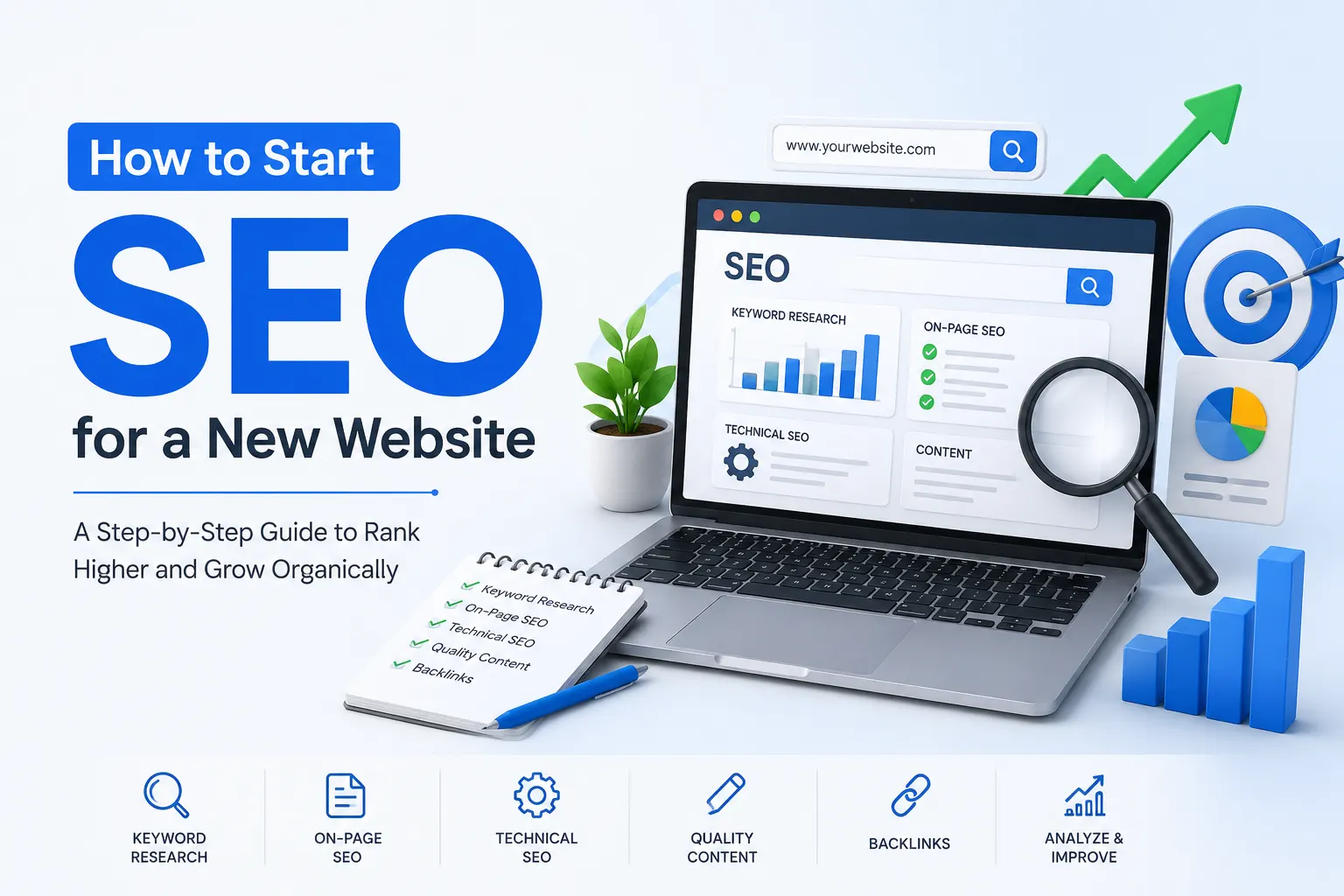
You launched your website. Now what?
Here’s the hard truth — having a website in Vancouver means absolutely nothing if nobody can find it. With thousands of businesses competing for the same eyeballs on Google, showing up on page one isn’t luck. It’s strategy. And the good news? You don’t need a massive budget to start. You just need the right roadmap.
This guide breaks down exactly how to start SEO for a new website in Vancouver — step by step, no fluff, no jargon.
What Is SEO and Why Does It Matter in Vancouver?
SEO (Search Engine Optimization) is the process of making your website visible on Google and other search engines when people search for your products or services.
Vancouver is one of Canada’s most competitive digital markets. Whether you’re a roofing company in Burnaby, a yoga studio in Kitsilano, or a tech startup in Yaletown — your potential customers are searching online right now. If your website isn’t optimized, they’re finding your competitors instead.
Local SEO in Vancouver focuses specifically on showing up when someone searches terms like:
- “plumber near me Vancouver”
- “best coffee shop in Gastown”
- “Vancouver web design company”
These searches have real buying intent. That’s where the money is.
Read Also : How Google Search Rankings Work and Ways to Improve Them
Step 1: Set Up Google Search Console and Google Analytics
Before doing anything else, you need to know how your website is performing.
Google Search Console is a free tool that tells you which keywords are bringing people to your site, which pages Google has indexed, and whether there are any technical errors.
Google Analytics shows you how visitors behave on your site — how long they stay, which pages they visit, and where they came from.
Both are 100% free. Go to search.google.com/search-console and analytics.google.com to set them up. Verify your website by adding a small code snippet to your site’s header.
This step is non-negotiable. You can’t improve what you’re not measuring.
Step 2: Do Local Keyword Research
Keywords are the foundation of SEO. These are the actual phrases your customers type into Google.
For a new website in Vancouver, you want to target keywords that are:
- Locally specific — include “Vancouver,” or Vancouver neighbourhoods like “Kitsilano,” “East Van,” “North Shore,” or “Burnaby”
- Realistic — don’t try to rank for “best restaurant Vancouver” on day one. Start with longer, specific phrases like “family-friendly Italian restaurant in East Vancouver”
- Intent-driven — target keywords where someone is ready to buy or book
Free tools to find keywords:
- Google Keyword Planner (free with a Google Ads account)
- Ubersuggest (free tier available)
- Answer The Public (find questions people ask)
- Google’s own autocomplete and “People Also Ask” section
Make a simple spreadsheet. List your target keywords, their estimated monthly search volume, and which page on your website will target each keyword.
Step 3: Optimize Your Google Business Profile
If you have a physical location or serve customers in Vancouver, your Google Business Profile (formerly Google My Business) is your single most powerful local SEO tool.
It’s what shows up in Google Maps and the “Local Pack” — those three business listings that appear at the top of local search results.
Here’s how to optimize it properly:
- Go to google.com/business and claim your listing
- Verify your business (Google usually sends a postcard with a verification code)
- Fill in every single field — business name, address, phone number, website, hours, categories
- Write a detailed business description using your target keywords naturally
- Add high-quality photos of your storefront, team, products, or work
- Use the “Services” section to list exactly what you offer
- Post weekly updates using Google Posts — share news, offers, or events
- Respond to every single review, both positive and negative
For Vancouver businesses, reviews are massive. Aim for at least 50 reviews to be competitive. To get reviews, simply ask your happy customers directly after a good experience. Make it easy by sending them your direct Google review link.
Read here Also : how to optimize google my business profile
Step 4: Fix Your Technical SEO
Technical SEO means making sure Google can actually find, read, and index your website properly. Even the best content won’t rank if your site has technical problems.
Here’s your technical SEO checklist for a new site:
SSL Certificate (HTTPS) — Your website must start with “https://” not “http://”. This is a basic Google ranking signal and also builds trust with visitors. Most hosting providers offer free SSL through Let’s Encrypt.
Mobile Responsiveness — Over 60% of searches in Vancouver happen on mobile devices. Your website must look and work perfectly on phones and tablets. Use Google’s free Mobile-Friendly Test tool to check.
Page Speed — Google measures Core Web Vitals — essentially how fast your pages load and how stable they are while loading. A slow website kills both rankings and conversions. Use Google PageSpeed Insights to check your score and follow the recommendations.
XML Sitemap — This is a file that lists all your website’s pages and helps Google discover and crawl them faster. Most CMS platforms like WordPress generate this automatically. Submit it through Google Search Console.
Robots.txt — This file tells Google which pages to crawl and which to ignore. Make sure it’s not accidentally blocking important pages.
Schema Markup — This is structured data code that helps Google understand your business type, location, services, and reviews. For a local Vancouver business, LocalBusiness schema is especially valuable. You can use Google’s free Structured Data Markup Helper to create it.
Step 5: Optimize Your On-Page SEO
On-page SEO refers to what’s actually on each page of your website — the content, headings, title tags, and meta descriptions.
Title Tags — This is the blue clickable link you see in Google search results. Every page needs a unique title tag under 60 characters that includes your main keyword. Example: “Plumbing Services in Vancouver | Fast & Reliable | ABC Plumbing”
Meta Descriptions — The short text that appears below the title in search results. Keep it under 160 characters and make it compelling — this is your sales pitch to get the click.
H1 Headings — Every page should have one H1 heading that clearly states what the page is about and includes your main keyword.
Content Length and Quality — For important pages, aim for at least 500-800 words of genuinely useful content. Don’t stuff keywords in unnaturally. Write for humans first, Google second.
Internal Linking — Link between your own pages. If you write a blog post about plumbing tips, link it back to your main plumbing services page. This helps Google understand your site structure.
Image Alt Text — Every image on your site should have descriptive alt text that tells Google (and screen readers) what the image shows. Example: alt=”Vancouver plumber fixing kitchen pipe”
Step 6: Build Location-Specific Pages
This is a strategy that most new websites in Vancouver skip — and it’s a huge missed opportunity.
If your business serves multiple areas, create dedicated pages for each location. For example:
- “Plumbing Services in Burnaby”
- “Plumbing Services in North Vancouver”
- “Plumbing Services in Coquitlam”
Each page should have unique content specifically written for that area. Don’t just copy-paste and change the city name — Google penalizes that. Mention local landmarks, neighborhoods, and community references to make the content genuinely local.
Similarly, if you serve different services, give each service its own page. Don’t cram everything onto one page.
Step 7: Start Building Local Citations
A citation is any online mention of your business name, address, and phone number (NAP). Consistent citations across the web tell Google your business is legitimate and trustworthy.
Key Vancouver directories and citation sources:
- Yelp Canada
- Yellow Pages Canada
- Canada411
- Better Business Bureau (BBB)
- Bing Places
- Apple Maps
- Foursquare
- LinkedIn (company page)
- Industry-specific directories (e.g., Houzz for home services, Zomato for restaurants)
The most important rule: your Name, Address, and Phone Number must be exactly the same across every single listing. Even small differences like “St.” vs “Street” can confuse Google’s algorithm.
Step 8: Create Helpful, Vancouver-Specific Content
Content marketing and SEO go hand in hand. Publishing useful blog posts, guides, and articles on your website establishes you as an authority in your industry and gives Google more pages to rank.
For Vancouver businesses, the best content strategy is hyper-local. Instead of writing generic articles, create content your local audience actually cares about:
- “How to Choose a Contractor in Vancouver’s Wet Climate”
- “The Best Neighbourhoods in Vancouver to Open a Restaurant in 2026”
- “What Vancouver Homeowners Need to Know About Basement Waterproofing”
Aim to publish at least one piece of quality content per week. Each article should target a specific keyword, answer a real question, and be at least 800-1000 words.
Step 9: Build Backlinks
Backlinks are links from other websites pointing to yours. They are one of Google’s strongest ranking signals. Think of each backlink as a vote of confidence from another website.
Realistic backlink strategies for new Vancouver websites:
- Get listed in local business directories (as mentioned above — these count as backlinks)
- Reach out to local bloggers and journalists who cover your industry
- Sponsor local Vancouver events — they often link to sponsors on their website
- Guest post on industry blogs — write a useful article for another website in exchange for a link back to yours
- Partner with complementary local businesses — a florist and a wedding photographer can exchange links naturally
- Get your business featured in local Vancouver media — Vancouver Sun, Vancouver Is Awesome, Daily Hive Vancouver
Avoid buying backlinks or using cheap link-building services. Google’s algorithm is sophisticated enough to detect unnatural links and will penalize your site for it.
Step 10: Track, Measure, and Improve
SEO is not a one-time task. It requires consistent effort over time.
What to track monthly:
- Organic traffic (Google Analytics)
- Keyword rankings (use free tools like Google Search Console or Ubersuggest)
- Number of backlinks (Ahrefs has a free version)
- Google Business Profile views and actions
- Conversion rate — are website visitors actually becoming customers?
Realistically, expect to start seeing noticeable results within 3 to 6 months for less competitive keywords. For highly competitive Vancouver keywords, it can take 6 to 12 months. Patience and consistency are everything.
How Long Does SEO Take for a New Website in Vancouver?
This is the most common question and the most misunderstood part of SEO.
Here’s an honest timeline:
- Month 1-2: Technical fixes, Google Business Profile setup, keyword research, foundational on-page optimization
- Month 3-4: Google begins indexing your content; you may see some long-tail keywords start ranking
- Month 5-6: Traffic starts growing; secondary keywords begin converting
- Month 9+: Primary keywords start gaining serious ground; clients stop asking “is this working?”
The more competitive your industry in Vancouver, the longer it takes. A niche B2B service will rank faster than “Vancouver real estate agent.”
Common SEO Mistakes New Vancouver Websites Make
Avoid these pitfalls that slow down or reverse your progress:
Targeting keywords that are too competitive too soon. Don’t go after “Vancouver lawyer” on a brand new site. Start with specific, longer-tail variations and build up.
Inconsistent NAP information. Your business name, address, and phone number must match everywhere online. Inconsistency confuses Google.
Ignoring mobile optimization. If your site doesn’t work well on a phone, you’re losing rankings and customers simultaneously.
Publishing thin, low-quality content. A 200-word page won’t rank. Neither will content that’s clearly just keyword-stuffed without providing real value.
Expecting overnight results. SEO is a long-term investment. Businesses that quit after two months never see the payoff.
Not asking for reviews. Vancouver consumers trust Google reviews heavily. If you’re not actively collecting them, you’re losing ground to competitors who are.
FAQ’s
1. Q: How much does SEO cost in Vancouver?
Professional SEO services in Vancouver typically range from $800 to $8,000 per month depending on the scope of work and competition level in your industry. For a new small business, a mid-range investment of $1,500–$3,000 per month with a reputable local agency is a reasonable starting point. You can also do significant SEO work yourself if you’re willing to invest 5–10 hours per week consistently.
2. Q: Can I do SEO myself or do I need an agency?
Absolutely, you can do it yourself — especially in the early stages. The steps outlined in this guide are entirely doable without hiring anyone. The advantage of an agency is expertise, tools, and time. The disadvantage is cost. Many Vancouver business owners start with DIY SEO and bring in an agency once they have revenue to support it.
3. Q: What’s the difference between local SEO and regular SEO?
Regular SEO focuses on ranking for broad, national keywords. Local SEO focuses specifically on ranking within a geographic area — like Vancouver or specific neighbourhoods within it. Local SEO includes optimizing your Google Business Profile, building local citations, getting local reviews, and creating content specific to your city or region. For most Vancouver small businesses, local SEO should be the first priority.
4. Q: Is Google Business Profile really that important?
Yes — possibly the single most important thing for a local Vancouver business. It determines whether you show up in Google Maps and the Local Pack (the three businesses that appear at the top of local search results). Many potential customers will find and contact you directly through your Google Business Profile without ever visiting your website.
5. Q: How many keywords should I target on a new website?
Start small and focused. For a new website, pick 5–10 primary keywords and make sure each has a dedicated, optimized page. As your site grows authority, you can expand your keyword targets. Trying to rank for 100 keywords on a brand new site spreads your effort too thin.
Final Thoughts
Starting SEO for a new website in Vancouver isn’t complicated — but it does require consistency, patience, and the right approach from day one. The businesses that win local search aren’t necessarily the ones with the biggest budgets. They’re the ones that show up consistently, provide genuine value to their audience, and never stop improving.
Start with the basics: set up your tracking tools, optimize your Google Business Profile, fix your technical SEO, and create content that actually helps your Vancouver community. Build from there.
Six months from now, you’ll look back and be glad you started today.